The DBTech45 Brief · updated four times daily

Wednesday, July 29, 2026

Microsoft's cloud results show AI demand converting into revenue, but Meta's cash-flow collapse and a broad market selloff expose the cost of the buildout. New agent tooling, restaurant earnings, Boston's injured lineup, and New Hampshire flood and operating risks complete the final file.

Filed at 9:00 PM ETBack to archive

On my radar

4 ranked stories
#1World & Markets

Microsoft's Azure growth and backlog turn AI demand into measurable revenue

Microsoft reported $90.0 billion in quarterly revenue, up 18%, while Azure revenue grew 43% and its contracted commercial backlog reached $678 billion. Microsoft 365 Copilot passed 30 million paid seats. Those are unusually concrete signs that businesses are paying for AI and cloud capacity, although the company's heavy infrastructure spending still makes cash conversion the metric to watch.

Traders work on the floor of the New York Stock Exchange during a volatile session.
Image: Associated Press
#2World & Markets

Oil jumps 7.3% as Wall Street sells off and the Fed holds rates

The S&P 500 fell 1.5%, the Dow lost 1,153 points, and the Nasdaq dropped 1.7% as chip shares weakened and Brent crude settled 7.3% higher at $88.09 after fighting with Iran resumed. The Federal Reserve kept its benchmark range at 3.5%–3.75%, with three officials preferring a rate increase. Higher energy and long-term borrowing costs can squeeze consumers and operators at the same time, so this is a real economic pressure signal rather than a one-sector wobble.

#3AI & Builders

OpenAI says GPT-5.6 cut its own production serving costs by 20%

OpenAI says GPT-5.6 Sol helped rewrite production GPU kernels, improve request routing, and tune workloads, contributing to a 20% reduction in end-to-end serving costs. Its agent harness also defers tool discovery, caps tool output by default, and preserves prompt prefixes for caching. For builders, the durable lesson is that agent economics are increasingly won in orchestration and verification, not just model choice; the performance claims remain company-reported.

#4Restaurant Business

Chipotle restores traffic growth but gives back margin to beef, freight, labor, and execution

Chipotle's comparable sales rose 2.2%, including 1% transaction growth, and digital sales reached 38.3% of food and beverage revenue. Restaurant-level margin fell to 25.2% from 27.4% as beef, freight, wages, and added hospitality labor cost more. Operators should read both sides together: menu, loyalty, and service rebuilt visits, but growth does not automatically protect profit.

World & Markets

4 stories

Microsoft's Azure growth and backlog turn AI demand into measurable revenue

Microsoft reported $90.0 billion in quarterly revenue, up 18%, while Azure revenue grew 43% and its contracted commercial backlog reached $678 billion. Microsoft 365 Copilot passed 30 million paid seats. Those are unusually concrete signs that businesses are paying for AI and cloud capacity, although the company's heavy infrastructure spending still makes cash conversion the metric to watch.

Traders work on the floor of the New York Stock Exchange during a volatile session.
Image: Associated Press

Oil jumps 7.3% as Wall Street sells off and the Fed holds rates

The S&P 500 fell 1.5%, the Dow lost 1,153 points, and the Nasdaq dropped 1.7% as chip shares weakened and Brent crude settled 7.3% higher at $88.09 after fighting with Iran resumed. The Federal Reserve kept its benchmark range at 3.5%–3.75%, with three officials preferring a rate increase. Higher energy and long-term borrowing costs can squeeze consumers and operators at the same time, so this is a real economic pressure signal rather than a one-sector wobble.

Meta's revenue grows 28% while free cash flow falls 91%

Meta generated $60.8 billion in quarterly revenue, but profit fell 14% and free cash flow dropped to $784 million from $8.55 billion a year earlier as legal, severance, and AI infrastructure costs rose. The company lifted the bottom of its 2026 capital-spending range to $130 billion. The contrast with Microsoft is the market's central AI question: growth is strong, but not every spender is converting it into cash at the same pace.

AI & Builders

5 stories

OpenAI says GPT-5.6 cut its own production serving costs by 20%

OpenAI says GPT-5.6 Sol helped rewrite production GPU kernels, improve request routing, and tune workloads, contributing to a 20% reduction in end-to-end serving costs. Its agent harness also defers tool discovery, caps tool output by default, and preserves prompt prefixes for caching. For builders, the durable lesson is that agent economics are increasingly won in orchestration and verification, not just model choice; the performance claims remain company-reported.

Google turns a coding agent into the control plane for an agent's full lifecycle

Google's new Agents CLI skills guide coding agents through scaffolding, deployment, identity, prompt-injection screening, evaluation, and publishing to Gemini Enterprise. Its example keeps live SEC and news retrieval in deterministic tools and measures citation and grounding failures before release. The useful pattern for small teams is one workflow with explicit tool boundaries and pass/fail gates instead of a prototype spread across consoles.

MCP's stateless core reaches Claude as adoption passes 400 million monthly SDK downloads

Anthropic says Claude will adopt MCP 2026-07-28's stateless request model, versioned extensions, and hardened enterprise authentication. It reports more than 400 million monthly SDK downloads and over 950 servers in Claude's connector directory. The scale makes the migration important: serverless deployment gets easier, but builders tied to old sessions and deprecated features still need compatibility testing.

Restaurant Business

4 stories

Chipotle restores traffic growth but gives back margin to beef, freight, labor, and execution

Chipotle's comparable sales rose 2.2%, including 1% transaction growth, and digital sales reached 38.3% of food and beverage revenue. Restaurant-level margin fell to 25.2% from 27.4% as beef, freight, wages, and added hospitality labor cost more. Operators should read both sides together: menu, loyalty, and service rebuilt visits, but growth does not automatically protect profit.

Wingstop opens 102 restaurants while domestic same-store sales fall 7.5%

Wingstop's system sales increased 5.3% because the chain kept adding stores, even as established U.S. restaurants posted a 7.5% sales decline on lower transactions. Digital represented 71.6% of sales, and lower wing costs helped company-store economics. The split is a warning against confusing unit growth with guest demand: franchise development can lift the system while individual stores weaken.

A judge approves Fat Brands' liquidation after its acquisition debt collapses the group

A federal bankruptcy judge approved Fat Brands' liquidation plan after roughly $1.3 billion of debt and a complicated capital structure forced the restaurant conglomerate into Chapter 11. Four buyers are taking control of its brands in sales totaling nearly $1 billion. The operator lesson is severe but simple: acquisitions cannot rescue weak financing, and brand cash flow does not erase balance-sheet risk.

Sports & Betting

2 stories
A Red Sox pitcher delivers during Boston's road game against the Athletics.
Image: MLB.com

Curtis Mead's fractured wrist restores Boston's trade-deadline urgency

The Red Sox lost 4-3 to the Athletics, ending a 10-game road winning streak, while an MRI showed newly acquired infielder Curtis Mead fractured his left wrist in his Boston debut. The offense again struggled before a late rally, and Boston remains 55-51. With the Aug. 3 deadline approaching, the injury reopens the need for a right-handed bat and exposes how little margin the lineup has behind its pitching.

SourcesMLB.com

DraftKings faces a class action over prediction-market sports contracts

A proposed federal class action alleges DraftKings Predictions offers sports wagers in states where online sports betting is illegal by labeling them event contracts. The complaint says the products are functionally similar to sportsbook bets; DraftKings has not lost the case, and the allegations are unproven. The suit adds consumer-liability risk to the broader fight over whether federal derivatives rules can bypass state gambling regulation.

Nashua & New Hampshire

4 stories
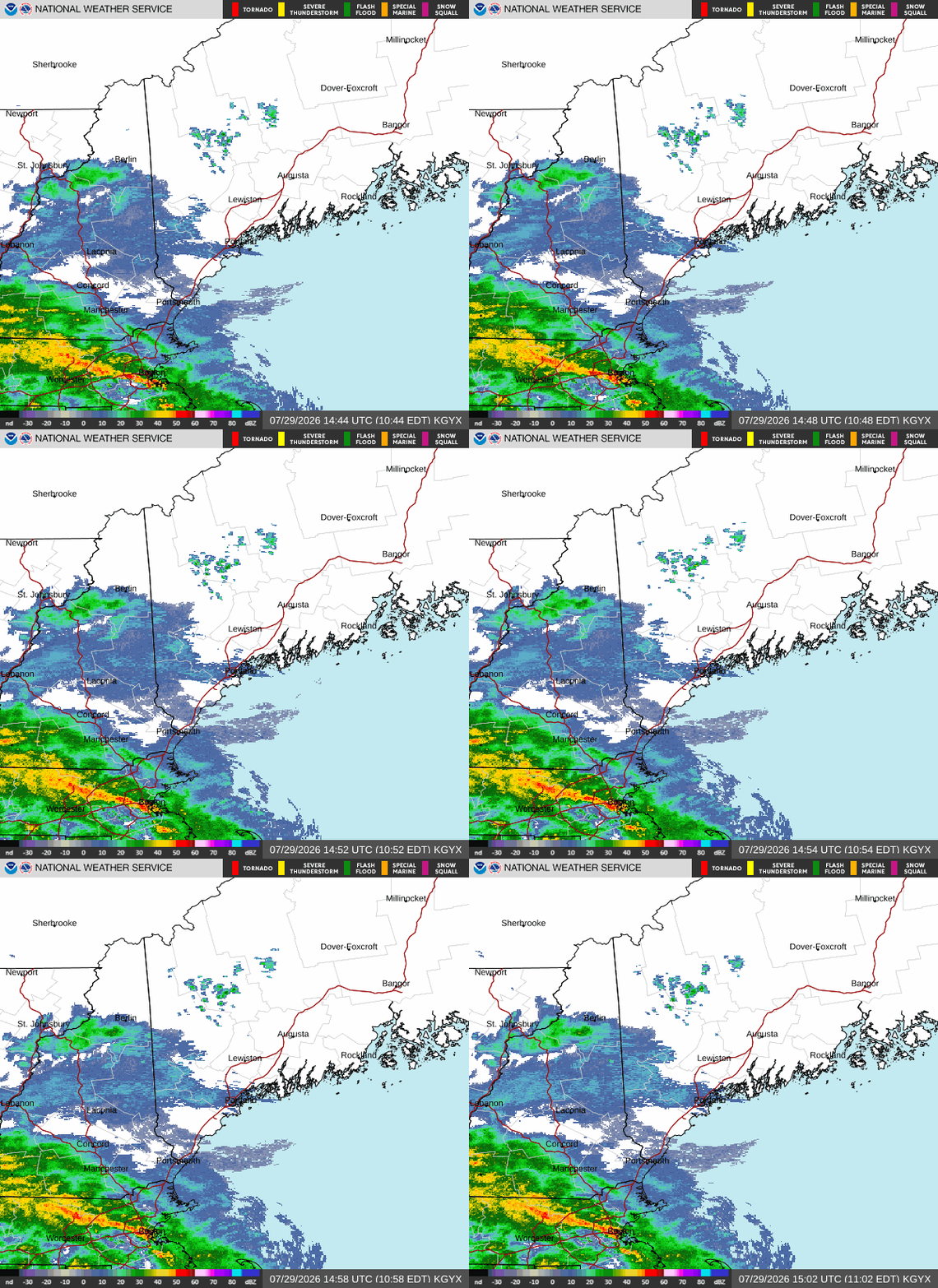
A National Weather Service map shows the New Hampshire area at risk for heavy rainfall.
Image: National Weather Service via NHPR

Flood watch covers much of New Hampshire as repeated downpours continue

The National Weather Service warned that repeated storms could produce localized rainfall totals up to five inches and flash flooding through Thursday morning, after streets already flooded in Manchester. A watch means flooding is possible, not certain. Southern New Hampshire operators should monitor local warnings, protect low-lying storage, and allow delivery and travel plans to change quickly.

Greater Nashua Mental Health will reunite services at a new Pine Street site

Greater Nashua Mental Health plans to open its renovated 3 Pine St. Ext. location on Aug. 10 after a February gas explosion destroyed its Amherst Street facility. Intake, substance-use, justice, older-adult, and accessibility services that have operated from temporary sites will return under one roof. The move restores operational continuity and places the programs near the organization's emergency services.

New Hampshire's university system proposes one leader for UNH and the statewide system

University System trustees voted 20-5 to combine the system chancellor and UNH president roles, subject to legislative approval. Supporters expect lower cost and faster decisions; opponents worry Keene State and Plymouth State could lose identity and attention. The proposal is a concrete response to declining enrollment and state funding, but it would not take effect before July 2027.

New Hampshire's housing law overrides local density caps in commercial zones

A retroactive state law allows multifamily housing by right in commercial zones and blocks most local density caps, conditional permits, and parking mandates above one space per unit. Nashua's proposed corridor-based density system is among the approaches the statute may override. Developers gain a clearer path, while cities retain site review and may require traffic, water, and sewer studies.